
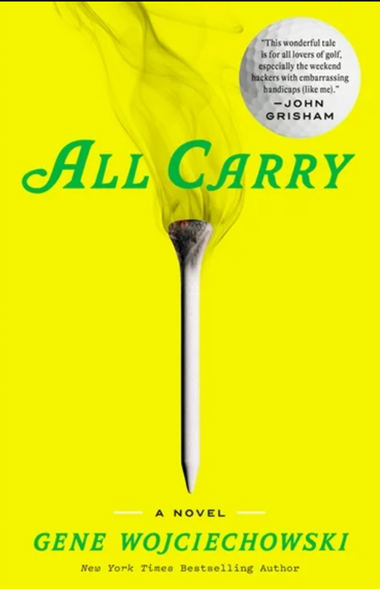
 Okay, we’ve got a dying old man with a set of antique clubs once fashioned for Jack Nicklaus, who at a garage sale gives them to a young man estranged from his father. Buddy gives the clubs to his dad, a mid-handicapper recently fired from a golf television channel, and only he can unleash their magical powers—400-yard-plus pinpoint drives. Dad hooks up with an unjustly ostracized Tour caddie and the pair ride the clubs’ mystical powers all the way to the Masters.
We’re not talking nonfiction here, folks. Gene Wojciechowski’s All Carry (Crown, $30), is best filed under golf fantasy. The plot is totally implausible, but if you decide to buy the premise, you’ll enjoy the ride.
Wojciechowski was himself let go a few years back after a long career with ESPN (print and on-air), and he’s clearly since made good use of his free time. He has the chops to surround his fictional cast with smatterings of real-life characters—like the late clubmaker Jack Wullkotte, who did indeed create clubs for Jack Nicklaus. And there is a reference to a pro who has his ID tracker riding around a course in a cart while he’s actually elsewhere cheating on his wife, a tidbit that’s been in the news lately. The author knows his golf contexts, so a backdrop of verisimilitude clings to an otherwise far-fetched tale.
There are two primary point-of-view characters. Max “Hard Way” Mitchell is the Tour caddie who unknowingly sleeps with the wife of his “man,” only to have the latter falsely accuse Max of improperly counting the number of clubs in his bag, leading to Max’s unemployability on the Tour.
Jack Riley is the suddenly unemployed sportscaster who starts booming 400-yard drives. Max takes notice, and is soon caddying for Jack and heading for the Tour. And the Masters. Max’s never-named former boss is the reliable heavy of the book, and inevitably, the only other contender in the final round with Jack in Augusta.
There’s a touch of “Tin Cup” here, and the father-son reconciliation of “Field of Dreams.” The book bulges past 400 pages, but it feels like a brisk read, with enough agreeable plot twists toward the end to provoke poignancy and pleasure.
* * *
I recently headed up to Stowe, Vermont, where the Beau Welling refashioned Stowe Country Club course was about to make its official debut. (It’s a beauty, by the way.) But the day before that event I went out solo on its sister course, the Bob Cupp-designed Mountain Course at Spruce Peak.
Or maybe it’s the bruiser big brother; it’s a tough course. I think I lightened my bag by about ten balls and stopped keeping score altogether all after awhile. Because it didn’t really matter. I just keep zooming around, in under three hours, enjoying having a splendid course all to myself. (Well, almost—two groups did let me through.)
I’ve played solo many times and I know the varied pleasures it can bestow—and problems, like finding your misfires. But Gary Belsky didn’t, until a business trip took him to a course where no one was around except the guy in the pro shop. So Belsky headed out alone for the first time ever, and experienced what he calls sporting transcendence.
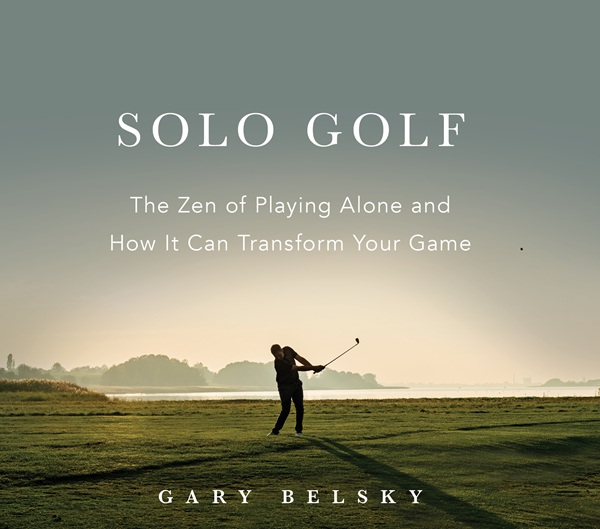
He lays it out in Solo Golf (Workman, $15.99), an under 150-page treatise on what the subtitle calls, “The Zen of Playing Alone and How It Can Transform Your Game.” Belsky, also an ESPN alum (the former editor-in-chief of ESPN The Magazine) is in no way saying that solo golf is the only way to play—he’s all-in on the camaraderie of the game.
But he does suggest that going it alone will awaken all sorts of wonders that he categorizes in ways semi-mystical, practical, and lighthearted, the latter in the sense of games within the game you can play when no one else is involved (taking two shots and then playing from the worst one, for example).
The mystical part is a series of meditations on such things as solitude, sound, focus, perspective, self-acceptance, imagination and “things”—like rental clubs. There aren’t really any earth-shaking surprises here, unless perhaps the reader has never actually played solo golf.
The book is broken up by golf quotes, seemingly unrelated golf sidebars (the best golf movies, books, songs). It’s brief, shaped like a slightly over-sized scorecard, so it might be worth slipping into your bag to wait for a rain shower to pass.
There is one glaring practical omission. Who has not, while playing solo golf, arrived at a par-3 with a sense of both anticipation and dread concerning a hole-in-one? You want it to go in, yet if it does, whom do you tell? If anyone?
Though Belsky poses the question, “Who’s going to sign my scorecard when I notch my first hole-in-one?” he egregiously never answers it. So we’re left with the metaphysical puzzle of the solo ace, wondering whether it is merely like a tree, falling silently, in an uninhabited forest.
* * *
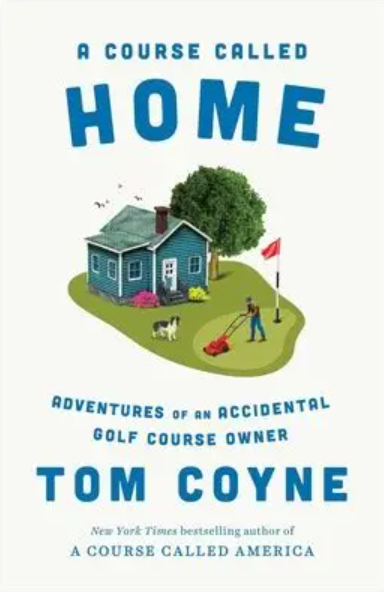 In A Course Called Home (Avid Reader Press, $30), the normally peripatetic Tom Coyne pretty much stays put in one place, the town of Liberty in the New York Catskills region. The man who played hundreds of golf courses across Ireland, Scotland and the United States and wrote best-selling books about all three odysseys more or less settles down in this one because he’s gone and bought a barely hanging-on nine-holer, the Sullivan County Golf & Country Club. But it’s still a journey.
This one may sound a little like “We Bought a Zoo.” Coyne has a novel in his canon and here he’s certainly come up with the narrative pulse of a tale tall, especially when actor Bill Murray and ex-footballer Jason Kelce get involved as co-owners. But we are talking nonfiction this time, folks.
The book opens with Coyne atop a mower, trying to cut a fairway, and we soon learn why he’s perched there. Back in 2023 he responded to a social media message about the course in Liberty struggling to make it to its 100th year. Thinking that it might make for a good article in the magazine he now edits, “The Golfer’s Journal,” Coyne figured he’d take a one-day trip to meet up with the superintendent, Shaun Smith. He winds up not returning home that night. Alea iacta est—the die is cast.
It all actually makes for a good book. Coyne leads us through a roughly month-by-month accounting of how one sets about to save a failing golf course, and there are plenty of laughs, hair-pulling frustrations, dicey monetary matters, the nitty-gritty of turf care, mollifying locals while courting out-of-towners, and plenty of deep dives into the many swirling emotions a stream of colorful characters encounter on the long and wholly uncertain endeavor.
 The now-renovated Sullivan County Golf Club has received ample publicity, so I don’t think we need a spoiler alert to say the course made it to its 100-year celebration and beyond and seems to be doing just fine, as a glance at its website should indicate.
But that in no way diminishes the many pleasures of reading the book, while provoking a desire to visit and play the course. Solo or otherwise.
This piece originally appeared in the 2026 Aug.-Sept issue of Golf Oklahoma in slightly different form.
# # #
Tom Bedell wishes his golf game remotely resembled his golf fantasies
