
By Anthony Pioppi
In late November, an email from a friend arrived in my inbox with the subject line, Ocean Links. Since it was from someone with immense knowledge of the long-gone, nine-hole Seth Raynor design that was in Rhode Island. I was immediately intrigued.
The email read, in part, “I just received the attachment from a friend. Have you seen it before?”
The answer was “no,” and what I was looking at made me instantaneously sit bolt upright. A gorgeous Raynor full-color drawing of five holes that pushed aside everything researchers and historians know about Raynor’s sketch style.
The drawing of holes three through seven is unique in the annals of Raynor, the only examples of individual hole sketches. Up until now, all of Raynor’s work are drawings of a complete course or courses. The Ocean Links plan, found at the Beinecke Rare Book and Manuscript Library on the campus of Yale University, is also the only known example of Raynor-Macdonald-Banks course rendering on grid paper. The spaces appear to be in increments of 30 yards.
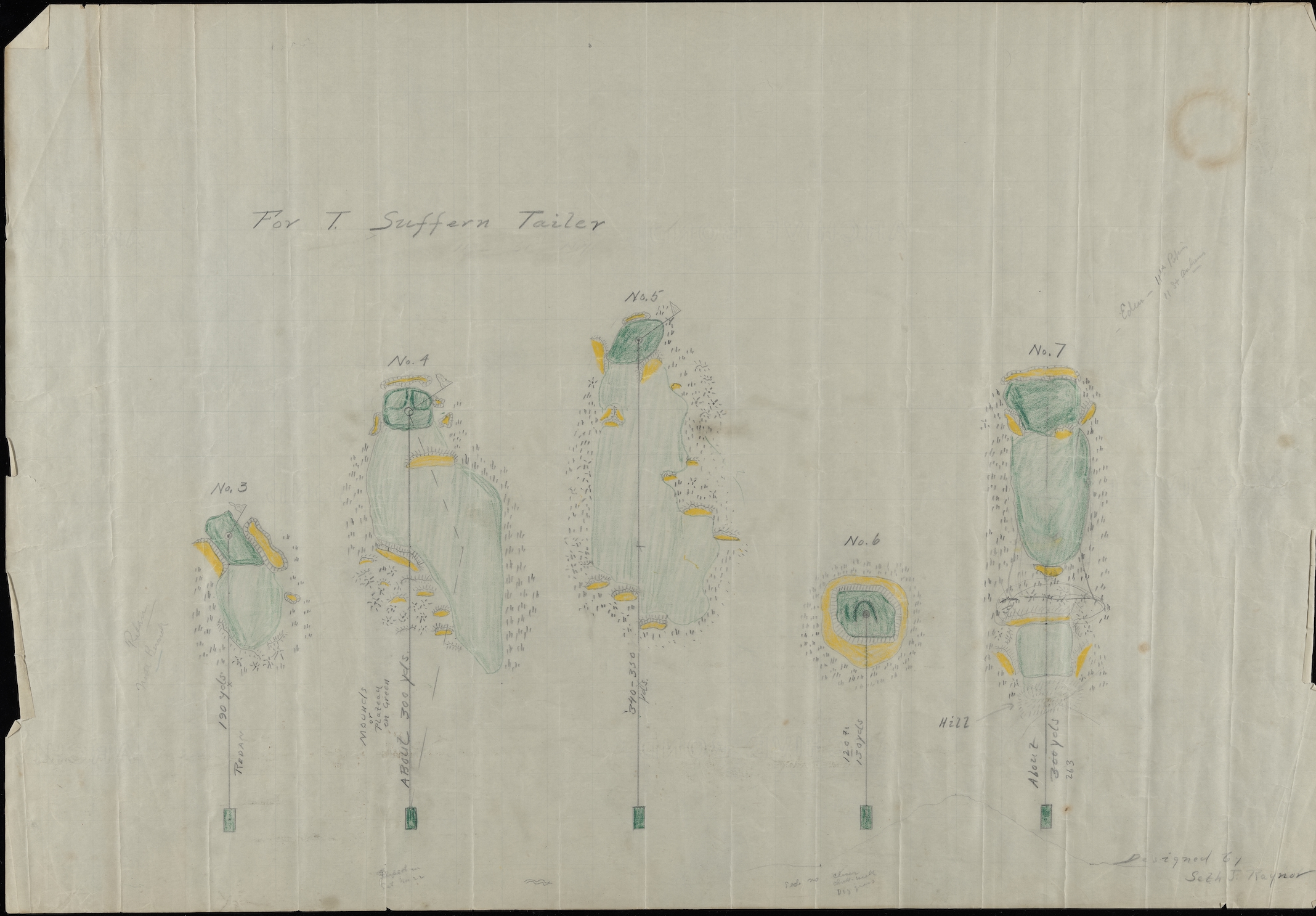
The Seth Raynor drawing of holes three through seven at Ocean Links. (The Annals of Tennis: by Julian Marshall. Beinecke Rare Book & Manuscript Library. Yale University)
There are no known examples of individual hole drawing for any of the courses of Charles Blair Macdonald, Raynor’s mentor. Raynor and civil engineer Charles Baird are known to have drawn for Macdonald.
Charles Banks, Raynor’s protégé, is thought to have once produced individual hole sketches. That for Blue Mound Golf and Country Club, a Raynor design, where Banks was hired to create a bunkering scheme in 1927.
Ocean Links opened in 1921 and, from 1923 to 1928, hosted the Gold Mashie golf tournament that featured some of the best amateur players in the world. The course was owned by T. Suffern Tailer, who was its only member. It bordered Newport Country Club, where Tailer also belonged. All Newport members had playing rights at Ocean Links. Legendary Rhode Island amateur Glenna Collett Vare held the women’s course record.
The original incarnation of the course closed in 1931. Tailer had died in late 1928 and his widow had no desire to continue the upkeep of the course. After going fallow, it reopened as the public Ocean Links Country Club in 1940 but was shuttered for a good in 1942 when the U.S. military took over the land for military installations at the start of the Second World War. The land where the five holes were is now part of Brenton Point State Park.
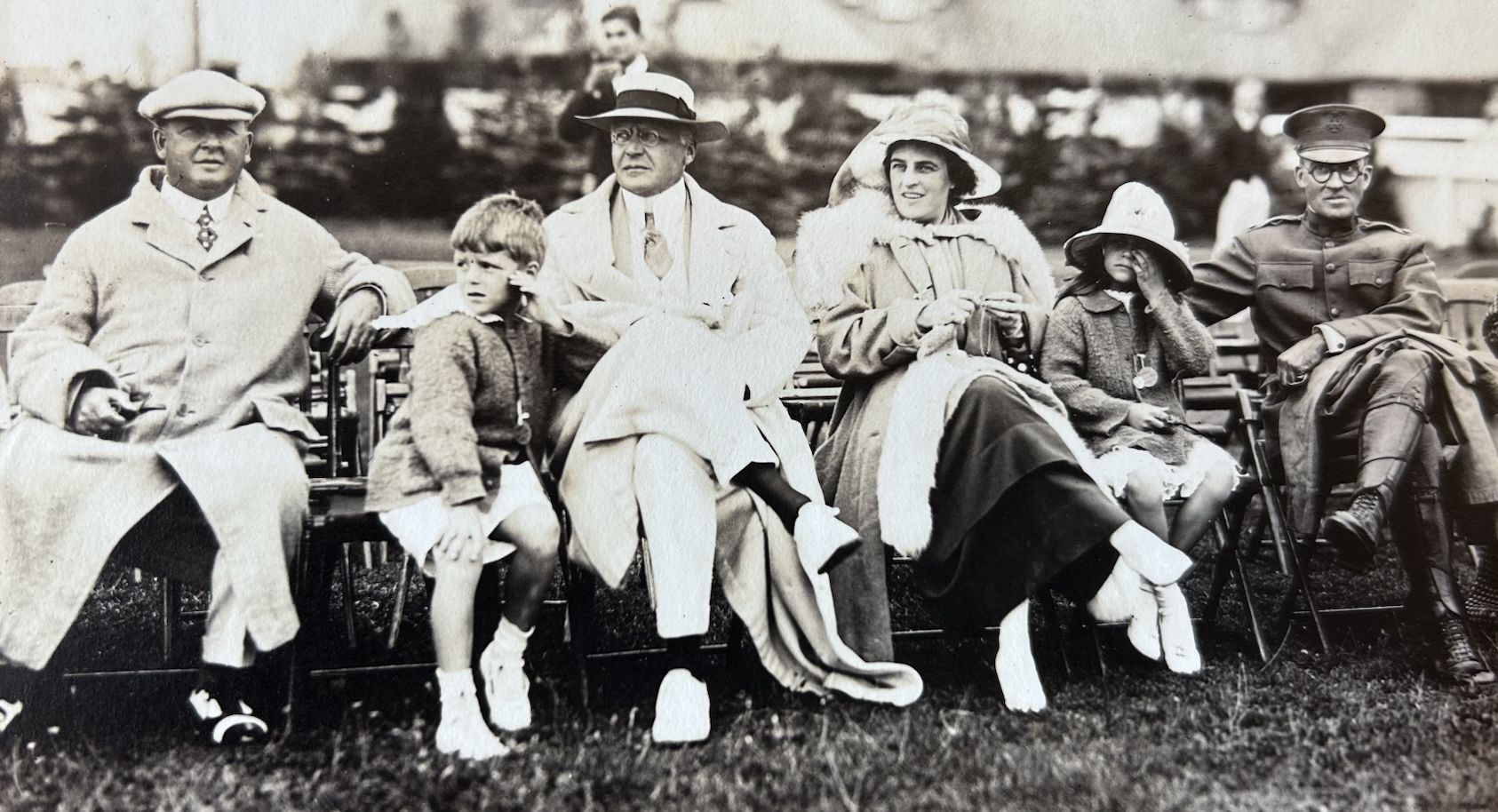
T. Suffern Tailer, in glasses and a wide-brimmed hat, with his family. His son Tommy, second from the left, was an accomplished golfer who was the low amateur in the 1938 Masters Tournament. (The Annals of Tennis: by Julian Marshall. Beinecke Rare Book & Manuscript Library. Yale University
The Ocean Links holes of the drawing are in order. The familiar hand of Raynor is evident on each one. The way the bunkers are drawn, with slashing lines indicating the faces, the sand bottoms are colored golden. There are the pale green fairways and a deeper green for the putting surfaces.
Adding to the fascination of the document are the pencil-written notes and a simple line drawing. The document is titled, “For T. Suffern Tailer.” In the bottom right-hand corner are the words, “Designed by Seth Raynor.”
Near the images of the third and seventh holes, Raynor also jotted down the inspirations for the Ideal concepts. “Redan, North Berwick,” appears next to the third, a version of that par-3 hole. Adjacent to the green at the par-4 seventh, a hole on the scorecard called “Hill to Carry, then the 11th St. Andrews,” are the words “Eden – 11th Piping, 11 St. Andrews,” referring to Piping Rock, a Macdonald design, and the Old Course.
The note confirms what Raynor researchers Bret Lawrence and Nigel Islam and I had already deduced, one of Raynor’s Ideal hole concepts that has eluded Raynor fans, was an Eden green at the end of a par-4. Examples include the eighth at Fox Chapel. Raynor also apparently intended that concept for the 13th at Mid Pacific. He died before the course was built.
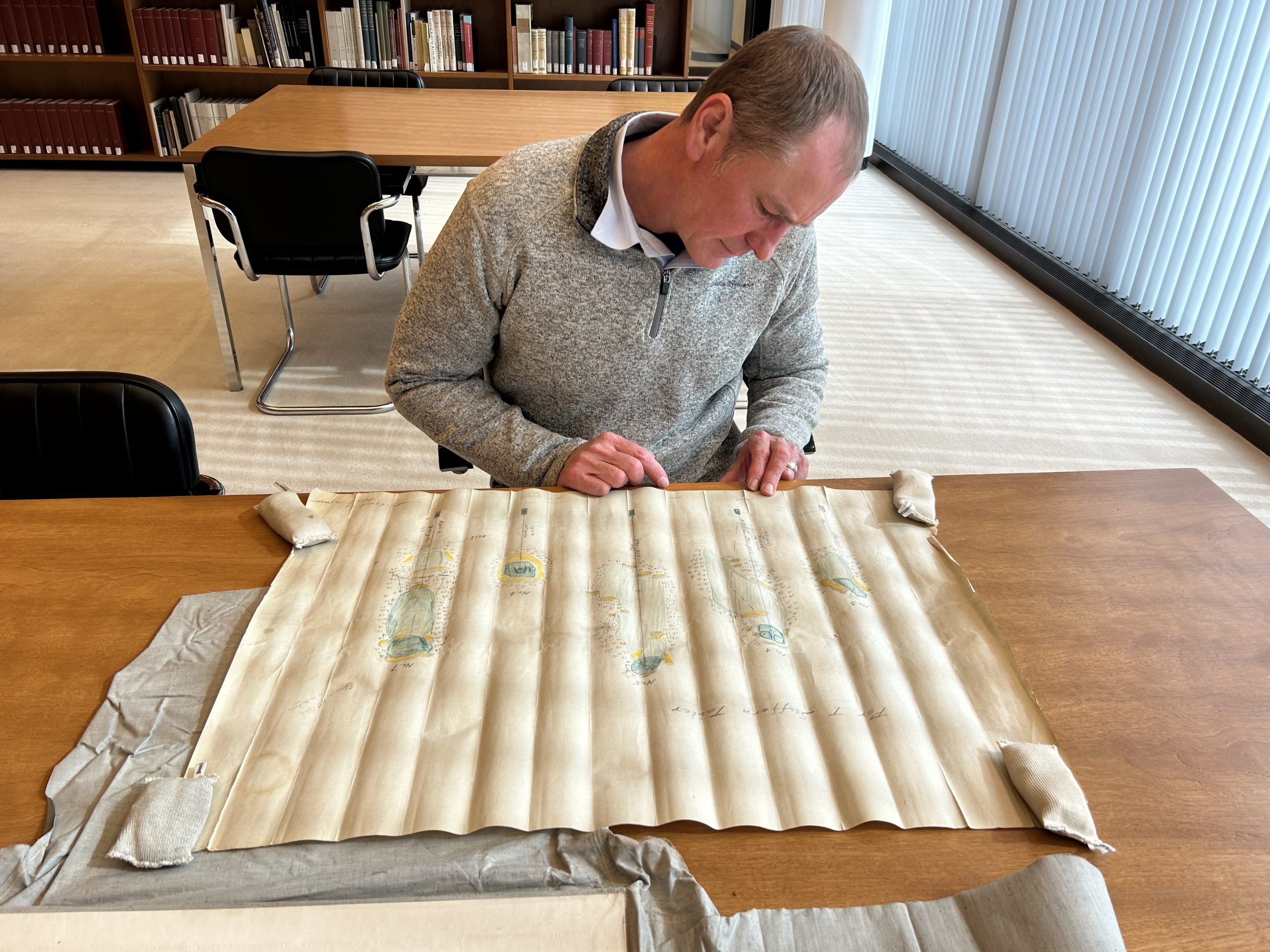
Seth Raynor expert Bret Lawrence studies Raynor’s Ocean Links drawing. (Photo by Anthony Pioppi)
On the fourth hole of the Ocean Links drawing, a version of the Valley Hole and on the scorecard called “Brenton Reef, 1st National,” Raynor jotted down, “Mounds or Plateaus on Green.” A close look shows the hole culminates in a Maiden Green, another Ideal concept.
That hole also proves that the Valley concept first found at the opening hole of the National Golf Links of America—a diagonal carry over bunkers where the bold line off the tee reveals an open route to the green for the approach shot—does not require an actual valley. The version at Ocean Links has an elevation change of about three feet from tee to green.
It appears when comparing the drawing to the known aerials of Ocean Links that most of the holes were not constructed with as much detail as sketched, with the exception of the par-3 third, which seems to follow Raynor’s plan.
The fourth, when built, however, appears to have four diagonal fairway bunkers, three short of the drawing. At the green, there is one less bunker. The one on the backside was not built. The aerials aren’t detailed enough to deduce whether it was a Maiden green.
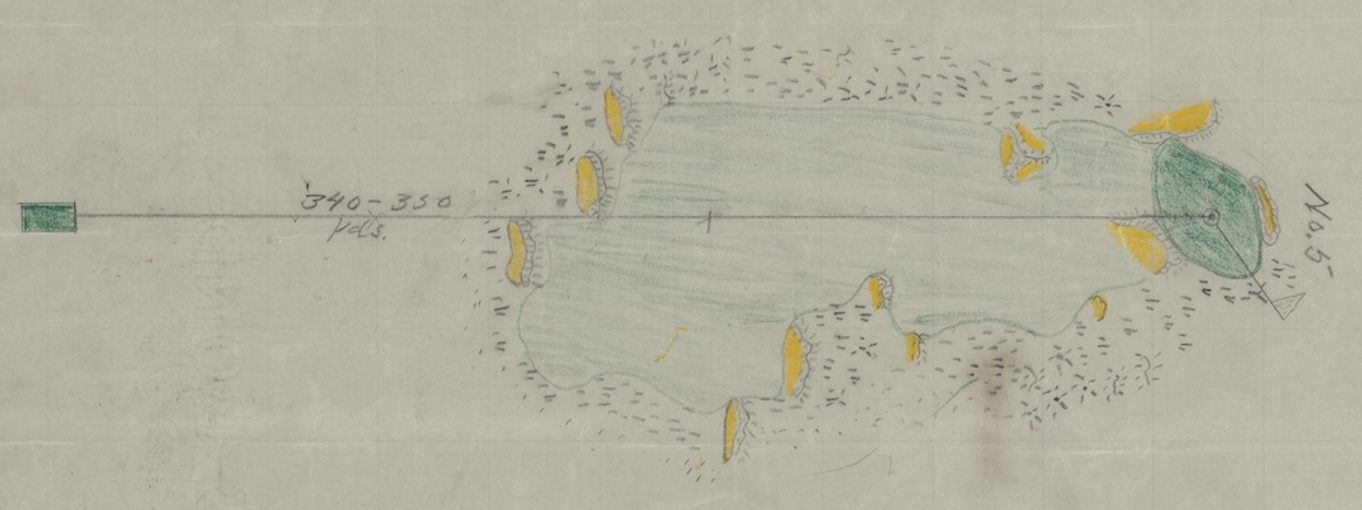
Seth Raynor’s drawing of the fifth hole at Ocean Links with its unique feature, a Principal’s Nose bunker on a Cape Hole (CThe Annals of Tennis: by Julian Marshall. Beinecke Rare Book & Manuscript Library. Yale University)
The fifth seems to deviate most from the drawing. This may be due to the fact that in 1924, Tailer altered the bunkering on the advice of noted amateur golfers Francis Ouimet and Jesse Guilford, two repeat participants in the Gold Mashie, reportedly with approval from Raynor and Macdonald.
The three left carry bunkers on the plan are reduced to two. The three right diagonal fairway bunkers, one fewer than the drawing, seem to pinch the landing area more than on the sketch. A Principal’s Nose bunker complex 30 yards short and left of the green, never made it into the ground.
This is an interesting twist from Raynor. In the Raynor-Macdonald-Banks collection of Ideal holes, a Principal’s Nose usually occurred on a hole that ended in a Double Plateau green and there are no known examples of it appearing on a Cape Hole.
At the green, three bunkers on the drawing—one front, one behind and one to the left—were replaced with a massive front bunker that connected to another thin one, which wrapped counterclockwise nearly all the way around the back of the putting surface. There was a break for a walk off, and then one more small bunker.
For the sixth, a Short Hole, Raynor threw in another unexpected twist. The traditional “horseshoe” feature for the green is found on the sketch, but in addition to the left of it is a ridge parallel to the line of play, the same length as the horseshoe, that would have created intriguing putts. It’s impossible to tell from the aerials if it was built.
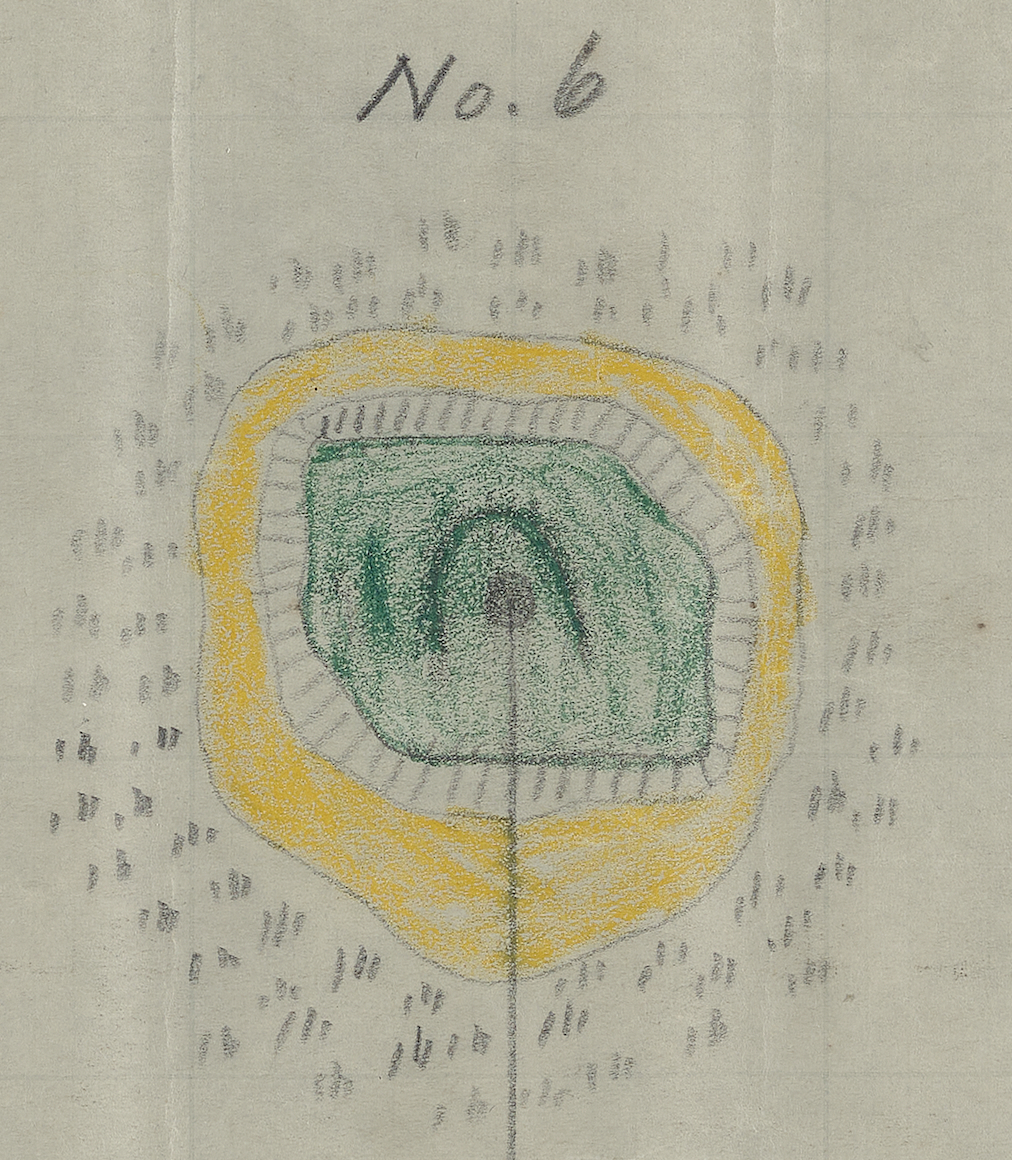
The Ocean Links version of the Short Hole has a unique ridge to the left of the traditional “horseshoe” feature. (The Annals of Tennis: by Julian Marshall. Beinecke Rare Book & Manuscript Library. Yale University)
For the bizarre seventh, on the scorecard called “Hill to Carry, then 11th St. Andrews,” the three bunkers short of the large, manufactured mound were not implemented and neither was a small bunker at the start of the fairway past the feature. The large bunker just over the hill and the four greenside hazards seem to adhere to the drawing.
There is one edit on the sketch. For the length of Hill to Carry, the original yardage was “about 300 yards.” That number was struck through with a single line and “263” written below it.
Only the Redan third has a precise length, that of 190 yards. The other holes have an approximate distance or vary by 10 yards.
A close inspection of the document also reveals a light pencil rendering of what appears to be a side view of the hill feature on the seventh. The single line is in the space between the sixth and seventh holes.
There is also a tantalizing second series of notes that are written in a hand that is not Raynor’s.
Below the tee of the fourth are four words. The first two seem to be “shaped in,” the third is unreadable and the fourth is “hill.” Just to the right are two parallel squiggly lines. A doodle or perhaps the top edge of a bunker? Below the sixth tee is a series of seven words. The best guesses have identified “no,” “clover” and “dog grass.” The word “chick weed” may be there, as well.
The drawing was discovered by accident in the Beinecke Rare Book and Manuscript Library at Yale University in New Haven, Conn., which houses, among other rarities, one of the 48 known copies of the Gutenberg Bible.
According to the person who rediscovered the Raynor drawing, the large folio containing it was one of six accumulated by Julian Marshall, a sports journalist and an authority on court tennis. Marshall wrote The Annals of Tennis, published in 1878, the first true sports history book. Marshall had planned a deluxe version with more illustrations and assembled about 1,000 engravings, maps, photographs and other material, but he died before that could happen. In 1906, the materials were sold at auction to Tailer, a huge court tennis enthusiast. The folder with the drawing contains mostly articles and photos about Tailer and his love of four-in-the-hand coaching, polo, and his Newport home, Honeysuckle Lodge. There is also a picture of Tailer from his senior year at Harvard with his fraternity brothers. Except for the Raynor drawing, there were no other items on Ocean Links or golf. The materials were sold again at auction in 1948 and purchased by Jock Whitney, who later donated them to Yale.
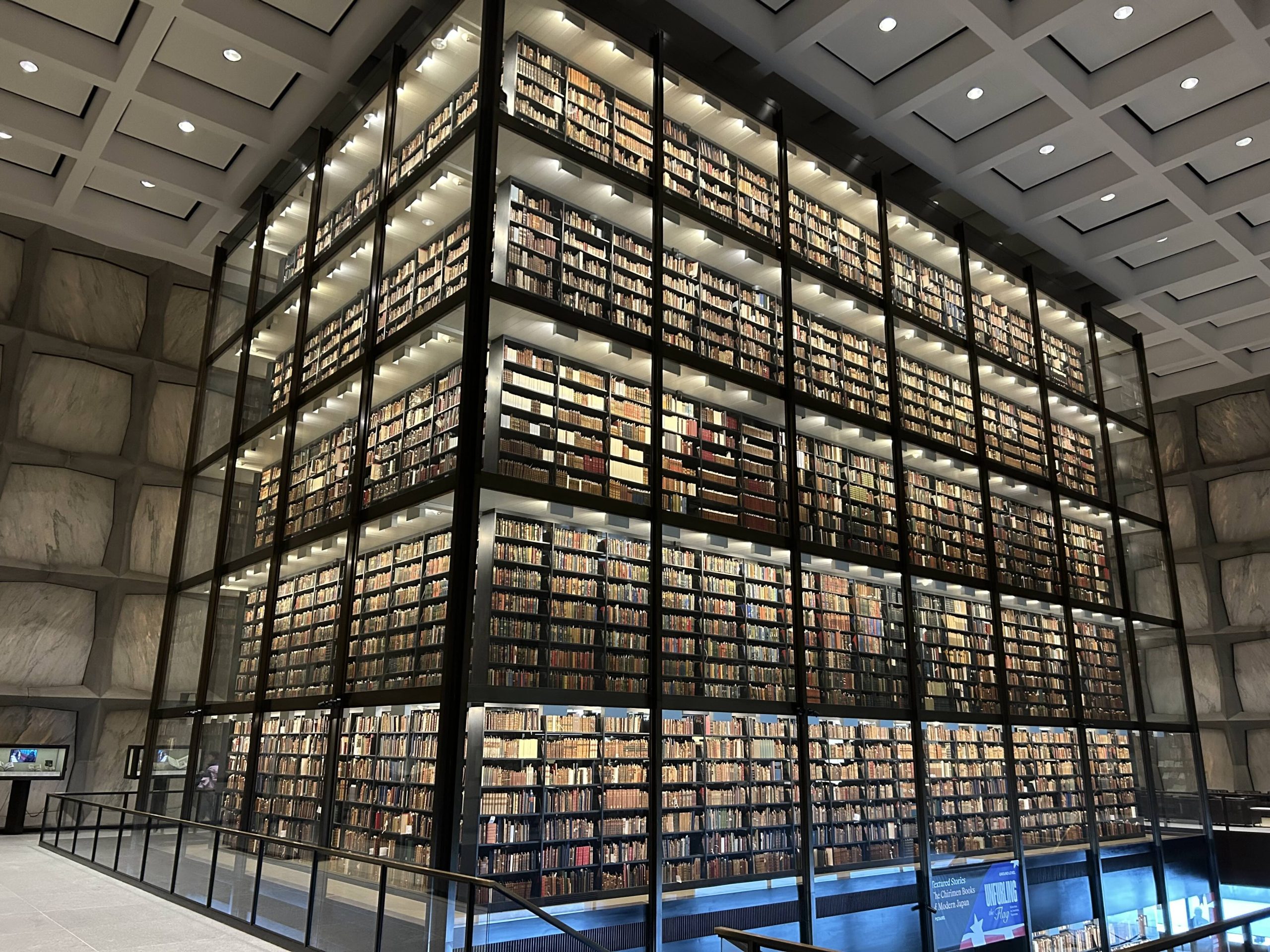
The interior of the Beinecke Rare Book and Manuscript Library, where Seth Raynor’s Ocean Links drawing is kept. (Photo by Anthony Pioppi)
In March, Lawrence and I traveled to the Beinecke Library to view the Raynor drawing. I have seen a few of Raynor’s originals, but I had never held one.
Opening the large, bound folder revealed the rolled-up 19 7/8-inch x 28 3/4-inch paper. It seems it had been included with the other items haphazardly, as if no one realized its importance. The Beinecke, until now, had no record of the drawing. It is not stored in a tube, and at some point in its history, it appears to have been squashed; deep creases run from top to bottom. Yet, once it was unrolled before me, even in its flawed state, it was stunning. The ability to hold and examine at length something created by Raynor’s hand was intimidating and mesmerizing.
I’ve been on almost all of Raynor’s surviving golf courses, but on those, the features, although dictated by Raynor, were the work of the person who drove a horse and drag plate. It was somebody else with a shovel and a rake that contoured the greens, even though they were to Raynor’s instructions or approval. The drawing, though, is solely the creation of Raynor. Even after spending nearly two hours with it, studying every square inch, front and back, I had to make myself return it to its home.
The obvious questions are: were there drawings for holes 1-2, 8-9? The answer is most likely. If it exists, however, it will probably take another extraordinary bit of luck to bring it into the light.
