
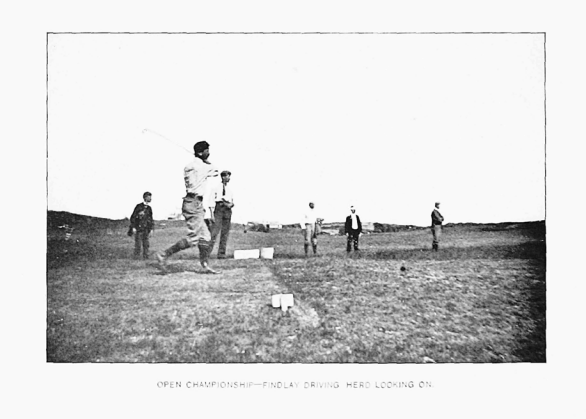
Alexander Findlay tees off at the 1898 U.S. Open as the eventual winner, Fred Herd, looks on
Isn’t that a great title? I certainty thought it was, right up there with “The Man Who Would Be King” and I looked forward to writing the article it was meant for. But I never did write it.
So, if John McPhee can dive into his desk drawer, rummage around old files and notebooks, churn out essays about the pieces he never got around to writing in his long and storied career, heck, so can I.
 Not that I’d otherwise compare myself to McPhee. The man is the creative nonfiction master, able to turn seemingly any subject into engrossing prose. Who else could get me to read about geology?
Now 95, McPhee has ostensibly hung ‘em up, but he keeps churning out these fascinating little pieces in The New Yorker about the stories he never got around to writing and he’s done enough of them that he put out a collection called Tabula Rasa. And the full title is Tabula Rasa, Volume 1, so it sounds like McPhee may have found another desk drawer to pilfer.
I have complete empathy for him. My office, a hardhat area, is teeming with Reporter’s Notebooks that I’ve filled with scribblings from around the globe that came to naught. True, most are illegible, especially the beer tasting notes, but I know there’s some gold in there.
Then there are the tapes, microcasettes, and phone recordings stored on the computer. Just thinking about the time it would take to listen to them, let alone transcribe them (though I’m sure there are apps for that) gives me indigestion.
 I was reminded recently of one golf story I never wrote, which was to report on a round I played with John Updike. I never wrote that one because I never played a round with John Updike. I think I probably could have arranged to play with the author, who was mad about the game and who put together his own collection, Golf Dreams, an essential volume for those with an affinity for the sport and for excellent prose.
Updike died before I thought to give it all a try. But James Dodson—who, as I’ve recently mentioned here attended the 2026 Brattleboro Literary Festival—did play with Updike. He wrote about the round twice, once for Golf Magazine and reprised in his book, The Range Bucket List.
As long as we’re this deep in the weeds, one more paragraph noting that Dodson has his own Substack page, and he’s revisiting some of his old pieces there, including the Updike round in a lengthy tale he calls “The Art of Gronkle.”
 As for The Range Bucket List, that was the book Dodson spoke about when he came to the Brattleboro Literary Festival in 2017. And I had previously reviewed it!, here.
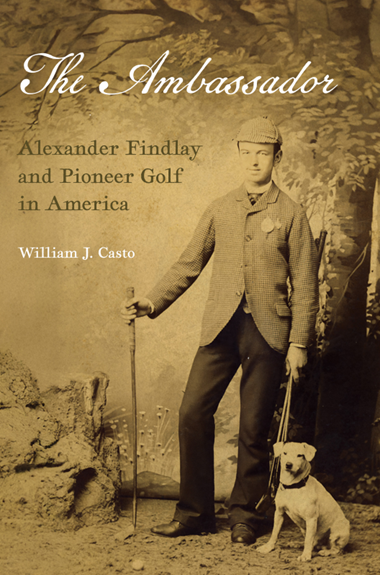
Okay, back to Alexander Findlay. subject of yet another book I reviewed, The Ambassador: Alexander Findlay and Pioneer Golf in America (Back Nine Press, $34.99) by William J. Casto.
Pioneer he was. As I note in my review (obviously titled “The Man Who Wanted to Golf With the Pope and Other Stories), Findlay left his home in Scotland and wound up in Nebraska with the goal of becoming a cowboy. But being golf-obsessed, he took to the prairie, “…resulting in episodes that sound like they’re right out of ‘Little Big Man.’ He whacked a golf ball on April 4, 1887 that Casto guesses is among the first confirmed strikes of one within the United States. Soon he laid out a six-hole course and tried to convince others to join him. Sioux Indians would watch him in amazed bewilderment, including Chief Sitting Bull. Buffalo Bill Cody saw it all and called Alex a ‘total idiot.’”
No, he was just a golfer. And by the time of his death at 75 in 1942, Findlay had pretty much done it all in terms of the game. He played credibly against the best of his times, he promoted the game tirelessly and brought players over from across the pond for exhibition matches, he designed courses and clubs and claimed to have played rounds at almost 2,500 courses worldwide.
I first became interested in Findlay due to my play at the Northfield Golf Club in Massachusetts when getting back into the game soon after moving to Vermont in 1991. Northfield is a terrific little nine-hole course that, I eventually learned, was a Findlay design from 1901.
 Casto’s deep research dives into Findlay’s design career turned up 165 courses he worked on in some fashion. Most no longer exist, though Casto thinks roughly 66 of them retain some elements of Findlay’s work. In Northfield’s case, that would be holes one, two, seven and nine. My first eagle came at Northfield’s opener, so I’ve got that going for me in Findlay terms.
I became more interested in Findlay when I had a gander at (though alas did not play) the gorgeous Dedham Country and Polo Club in Massachusetts, which I thought at the time he had also designed. Well, he did, but Donald Ross redesigned a nine-hole course there in 1915, and then Seth Raynor took it to 18 in 1925.
I don’t remember when I heard about Findlay’s plans for a six-hole course at the Vatican. But at some point years ago I tracked down Findlay’s grandson, Richard, who was in possession of the family archives. Or maybe he told me about the Vatican plans. In any case, that’s when inertia set in and the notion moved to a distant back burner.
When Casto’s book appeared I was both pleasantly surprised and not a little envious. He’s done a bang-up job in presenting his case that Findlay should most certainly be installed in the Golf Hall of Fame.
And the Vatican section, if brief, is solid and funny. Findlay apparently visited the Vatican twice in hopes of getting Pope Pius XI to take up the game—and thereby piquing the interest of Catholics worldwide in having a go. He was unable to see the Pope on the first visit but did take a look at the grounds. He scored an audience the second time, with clubs in hand and plans for a six-hole course.
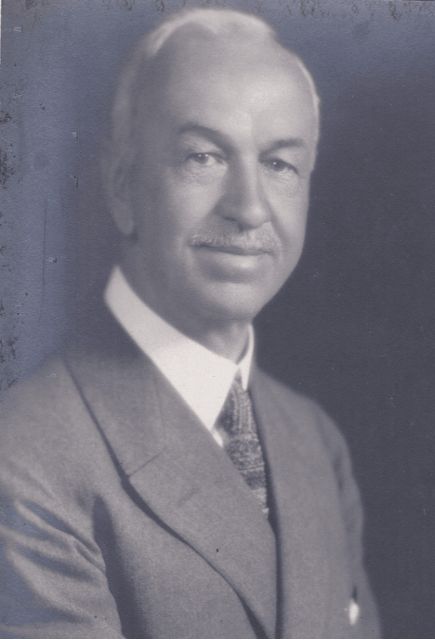
Findlay looking dapper around 1925 (AF photos courtesy of Bill Casto)
The Pope, however, was unmoved, and never gripped a club. Findlay had it in mind to try again, but before he could mount a third campaign the Pope died in 1939. So, too, Findlay’s efforts.
I contacted Casto recently and asked him if those Vatican plans had ever surfaced? He said, “Unfortunately, no plans for the Vatican course survive. Based on the descriptions, it seems like Alex brought some plans with him to the Vatican, but they were not uncovered within the Findlay family archives.
“In fact, so far as I know, there is only one golf course architectural plan from Alex Findlay in existence—Walnut Lane Golf Club from the 1930’s. And there is one partial plan for Pittsburgh Field Club from 1912ish. In general, Alex designed his courses on the ground, using the old staking method he inherited from Old Tom Morris.
“I was hoping that there would be some diagrams, sketches, or plans when I dug through the family archives, but alas, there were none. In some letters, he refers to some sketches that he made for the club committees and for the course builders, but none survive.”
So until a movie is made of Findlay’s life, thereby ends the tale. Though not without the kicker that as I was going through the list of Findlay-designed courses I came across the forerunner of the Brattleboro Country Club, the no longer existing Wantastiquet Golf Club.
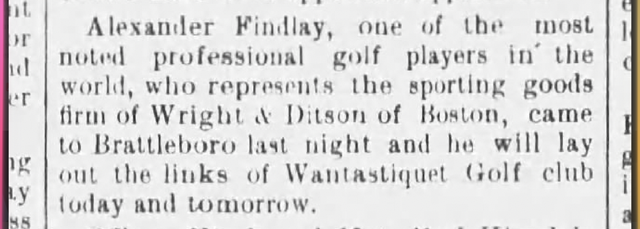
As Casto puts it: “Findlay went to Brattleboro to lay out the links at Wantastiquet Golf Club in June 1900. The course was six holes long and Findlay, true to his nature, described it as the best six-hole course he had ever visited.”
If it went according to the plans reported in the Vermont Phoenix of June 22, 1900, not bad for two days’ work:
This post first appeared in my Substack, Tom’s Bedellicatessan.
