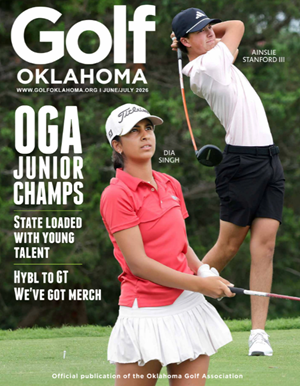
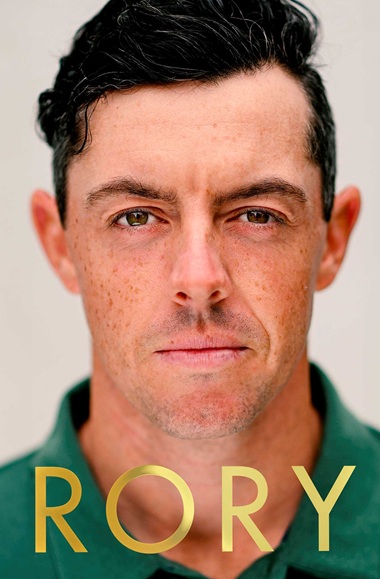
 There was a lot of social media chatter around Masters time this year about Alan Shipnuck’s
Rory (Avid Reader Press, $32.50). There were typical extremes of opinion about the book’s very existence, and in its preface we quickly learn about Rory’s initial dubiousness about the project. But the book’s subtitle—“The Heartache and Triumph of Golf’s Most Human Superstar”—gives away that it’s no hatchet job.
It’s a mostly admiring look at the golfer who is the sixth man to achieve the career Grand Slam, and who of course put icing on the cake this year with his second, and consecutive, Masters victory.
I had hoped but was unable to get my hands on Timothy Gay’s Rory Land: The Up-and-Down World of Golf’s Global Icon (Regalo Press, $35). Gay’s book preceded Shipnuck’s effort but had the misfortune to come out shortly before McIlroy completed his career Grand Slam.
McIlroy now stands at six major victories—the two Masters along with a U.S. Open (2011), an Open Championship (2014) and two PGA Championships (2012 and 2014). He has 30 wins on The PGA Tour and 21 on the European Tour. He has a lovely wife and daughter, is on his way to becoming a billionaire. It’s a little hard to comprehend what heartache or downturn his career has really taken.
Okay, there was an 11-year gap between major victories and the elusive Masters title ever since 2011, when McIlroy blew what appeared to be a sure thing, a four-shot lead in the final round. As Shipnuck puts it, “… lacking the asshole gene that is prominent in so many great golfers, McIlroy spent a full decade as a semi-tragic figure, serially failing in the tournaments that meant the most.” That pent-up frustration was publicly and explosively released on the 18th green last year at Augusta, and all but a few curmudgeons were happy for the young lad from Ireland.
All that said, Shipnuck’s book is hardly hagiography. He details a certain impulsive ruthlessness in McIlroy’s career and life, such as abrupt changes in managers, caddies or girlfriends, like the quickly ended engagement with tennis star Carolyn Wozniacki after the wedding invitations had been sent out. Or filing for divorce from his wife, Erica Stoll, only to rescind the papers a month later.
Yet he remains one of the most open of all players, now a leader of the sport outspoken in Tour doings and a key figure in the ongoing LIV muddle. “McIlroy contains multitudes,” Shipnuck writes, and he does a splendid job in compiling them.
* * *
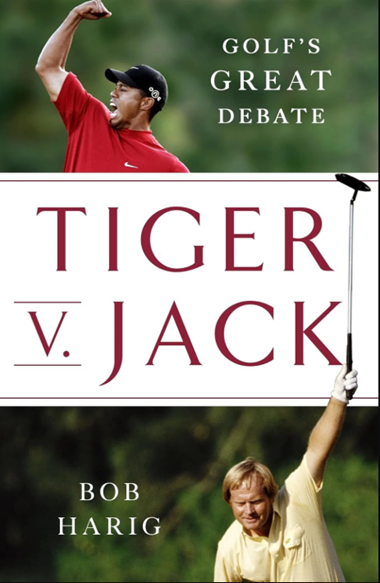 McIlroy is clearly a leading figure bridging the Tiger Woods epoch, but that doesn’t mean scribes are finished with the latter. In Tiger V. Jack: Golf’s Great Debate (St. Martin’s Press, $30), Bob Harig has dipped into the Woods well for the third time.
There was Drive: The Lasting Legacy of Tiger Woods (reviewed here) and Tiger & Phil: Golf’s Most Fascinating Rivalry (reviewed here).
Much as he did in the latter book, here Harig stacks two of the game’s greats and attempts to answer the decades-old debate, who was better?
Well, spoiler alert: there’s no clear answer, though Harig pretty well puts the argument to rest by page 45, when he quotes two-time major winner Mark O’Meara: “…Tiger Woods is the greatest player I’ve seen. If you go straight by record, you cannot deny that Jack Nicklaus has the greatest record. Tiger doesn’t. But I’ve never seen anybody play like Tiger.”
And so it goes, as Harig puts various aspects of each player’s careers head-to-head: their intimidation factor, their style of play, their comparative longevity, the different depths of talent during their careers. Some of this gets a little repetitive and one’s eyes may begin to glaze over. But Harig also puts a couple of statistical analysts to work to see what they make of it all.
In the end they can’t seem to grapple with the depth of talent factor to arrive at a precise verdict. They acknowledge that Nicklaus played against a relatively less-talented pool of players than Woods, but what does it all mean?
Nicklaus won 18 majors, Woods 15. Case closed. Or is it? This year is the 40th anniversary of Jack’s 1986 Masters win, his 73rd and last win on the regular Tour. Woods has won 82, and in fewer tournaments played. “From first start to last win, Woods played 345 [events] to 469 for Nicklaus.” Thus Woods has a higher career winning percentage. Case closed?
Harig also puts the pair up against some of the other acknowledged greats—Hagen, Bobby Jones, Hogan. It all amounts to an in-depth look that basically puts us back to where we were with O’Meara on page 45. Still, all the varied comparisons should arm readers to the teeth for when the debate goes on, and on, and on, in all the 19th holes in all the lands, forever.
* * *
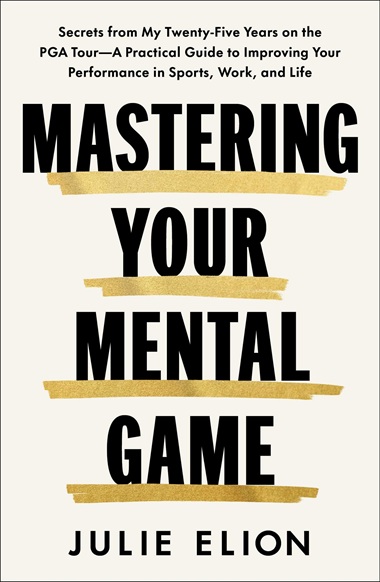 The intimidation that Nicklaus and Woods provoked in their fellow players was often attributed not only to their remarkable skills, but the intensity of the focus on their games. In Mastering Your Mental Game (Avid Reader Press, $30), Julie Elion doesn’t promise she’ll turn you into a Grand Slam golfer. But improvement? Sure, if you’re willing to put in some work.
I’d never heard of Elion until her book showed up at my door; the low profile she’s kept (until now) earned her the nickname “Stealth” from the pros she’s worked with. But lately she’s become known as “Backhoe,” since her particular brand of mental coaching involves digging deep into whatever in the past may be hindering one’s present.
Whatever her nickname, her methods have appeared to work. She claims that her clients have accounted for more than $500 million in career earnings, more than 150 PGA Tour wins and 25 major championships, and I find no reason to doubt her. Better to pay attention to what the subtitle calls “Secrets from My Twenty-Five Years on the PGA Tour—A Practical Guide to Improving Your Performance in Sports, Work, and Life.”
I’ve read more than a few of the many behavioral golf guides out there, and I had a typical reaction to this one. All the advice seems spot on, commonsensical even. Yet leaving me a little uncertain as to how to best bring the advice to the course myself, without actually having Elion alongside me.
Not that she doesn’t suggest ways. I suppose it’s up to me to try one of her sharpest suggestions: “I always start by asking clients to send me two lists. The first: ten things you’re great at mentally, both on and off the golf course. The second list: ten things you need to improve. The framing is important. It’s positive. These aren’t ten things at which you’re bad. They’re ten elements that need work…. Thus begins the examination of your golf game. Or your life. Or both.”
Most of her clients remain confidential, but Elion offers ample examples of her work from those willing to acknowledge the relationship, including Wyndham Clark, Max Homa, Justin Thomas. She weaves these into sections on controlling anger, methods of sustaining a non-censorious stance about your errant play (“Observe, don’t judge”), tools to maintaining clarity and focus while playing.
She advocates for meditation off the course, tackles grief and mental health in general and, well, I’m noticing about a dozen other dog-eared pages in the book I’ve marked for review. I feel better already.
# # #
Though younger, Tom Bedell shares a birthday with Jack Nicklaus. The similarity ends there.
This piece originally appeared in the 2026 June-July issue of Golf Oklahoma, in slightly different form.