
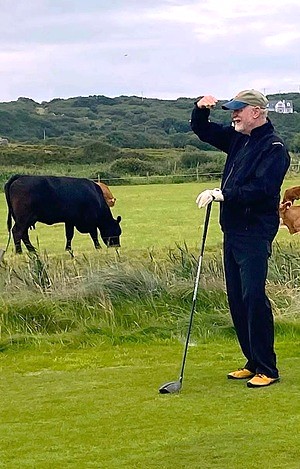
Author with cows at Narin-Portnoo – photo by Dave Lockhart
Five rounds of links golf in northwest Ireland in the middle of July—what could be better? Not much is a good guess. Along with a troupe of golf writers I had the pleasure last year (2025) of sampling a quintet of great courses in what the Irish tourist folks like to promote as part of the Wild Atlantic Way, not long after Scottie Scheffler had hoisted the Claret Jug at Royal Portrush in Northern Ireland. (Kudos to Ryan Fox for his sterling play this year at Royal Birkdale.)
We played in the counties of Donegal and Sligo in the Republic of Ireland, which is west of and partly further north than Northern Ireland. But to get from Dublin Airport to the first course on our itinerary we frequently wove in and out of both countries. They looked the same, you just had to realize that at one point you were looking at Irish cows and a few kilometers up the road at U.K. cows.
There is, it is obvious, a plenitude of great courses in Ireland, and more than 50 of them links courses hard by the sea. But the concentration in the northwest is to be envied and, as we discovered, replete with wonderful off course pleasures in terms of food, drink and hospitality.
Indeed, we settled into our first pints of Guinness at the Ballyliffin Lodge and Spa. From its terrace we could spy the clubhouse at Ballyliffin Golf Club where we would tee it up the next morning in a light mist, though the weather was cool and mostly fine all week.
Ballyliffin is the northernmost golf on the entire island. Along with a par-3 Pollan Links course there are two 18-hole tracks, the Old Links and the newer Glashedy Links. Though the club was officially established in 1948, the Old Links are actually fairly new, nine holes debuting in 1970 and a second nine in 1973, designed by the grand old man of Irish golf design Eddie Hackett, with an assist from English architects Frank Pennick and Charles Lawrie.
According to the club’s general manager, John Farren, Nick Faldo flew in by helicopter one day to play nine holes and was so taken with the course he kept on going, and then made an offer the club couldn’t refuse. So Faldo Design came up with plans for the Old Links renovation, “though we did most of the work ourselves in 2006, and then made Faldo an honorary member,” said Farren.
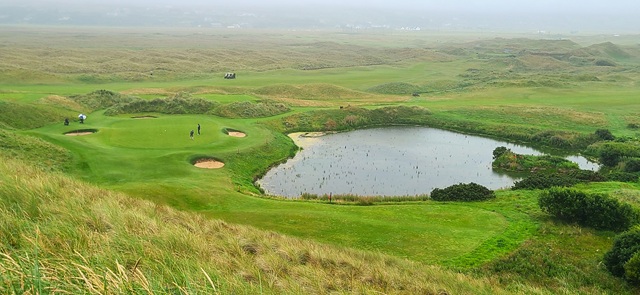
Glashedy seventh, Lake of Tears
It was Pat Ruddy and Tom Craddock who, according to the club history, were commissioned to “create a world class championship course,” and they delivered, the Glashedy Links opening in 1995.
Farren said, “The Irish Open was played on the Glashedy Links in 2018 and the Amateur Open Championship in 2024 on both courses, so that gives you an idea of the quality of both. But it’s the contrast between the two that people remember. The Old is an easier walk on lower ground, but it runs closer to the shoreline so it’s probably more scenic, right on the ocean.”
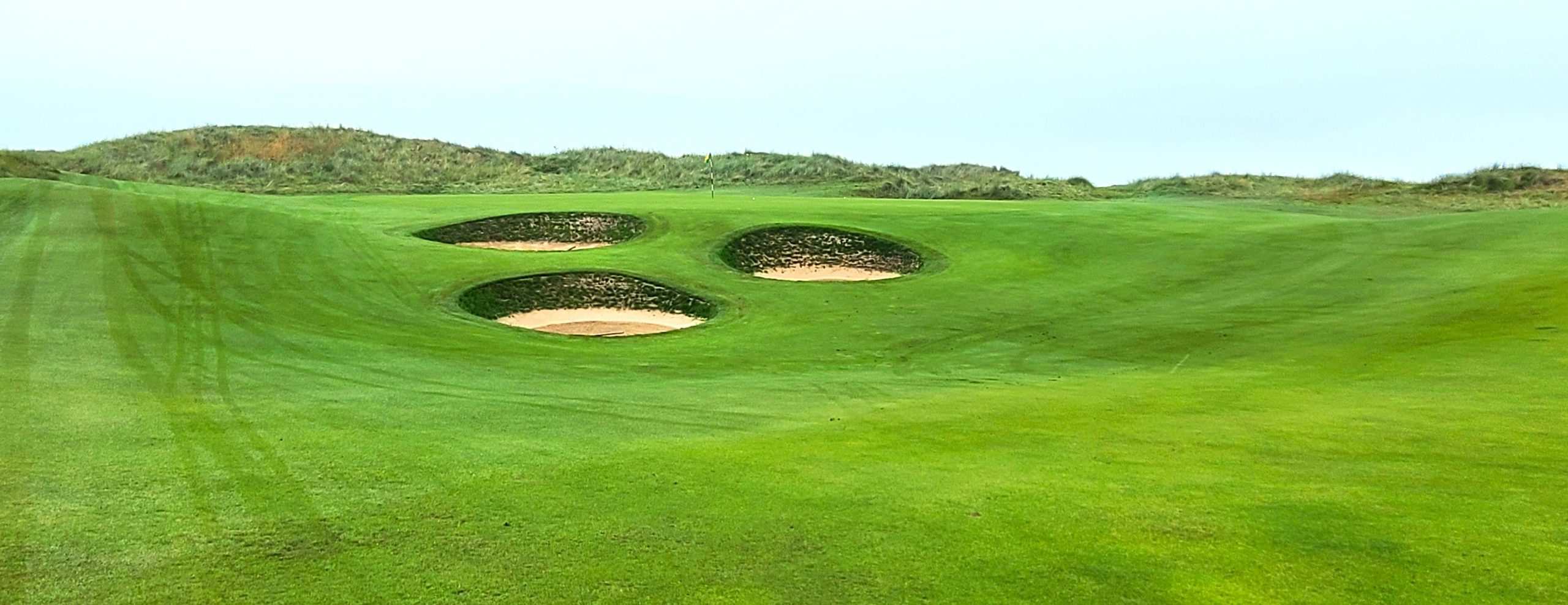
Glashedy: Oh, those pot bunkers
Glashedy is the more muscular and dramatic course, and the tougher of the two, but both are testament to the glories of links golf. There was more glory to come.
That night we stayed at The Waterfront Hotel in Dungloe, a town so immortalized in the song “Mary From Dungloe” that an annual Mary From Dungloe International Festival is held each year in late July. Both a pageant to pick out the year’s reigning “Mary” and a music festival, the event has been held since 1967 and towns from around the world send contestants. We missed the festival by mere days though the fix may have been in last year: the winning Mary was Ellie Ward, from Dungloe.
(The Irish folk group Emmet Spiceland had such a hit with the tune that it is said to have inspired the festival’s beginning. Have a listen:)
Named for adjoining towns, the Narin & Portnoo Links is another must-play in the area, a wild romp in nature amidst heaving dunes and hard by the Atlantic, with consistently stunning views of Gweebarra Bay.
Golfers have roamed these rugged grounds since 1905. A locally designed nine holes took shape in 1930, and an expansion to 18 in 1965. The club was falling on hard times about a decade ago when the transplanted Irishman Liam McDevitt—who had often played the course in his youth—and his Irish-American partner Larry Foley assumed the debt and ownership of the course. (McDevitt has since stepped down.)
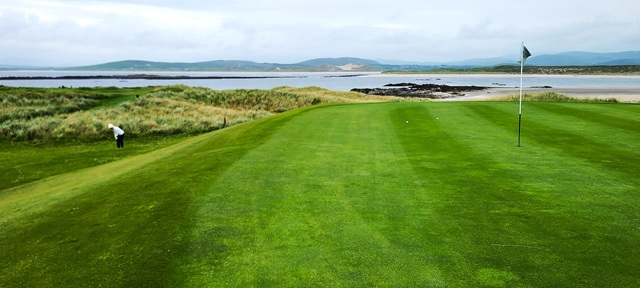
Grass, sea and sky at Narin & Portnoo Links
The pair had the sense—and the luck—to engage Gil Hanse and Jim Wagner to revitalize the course, which they did in spectacular fashion over the course of two years. I was lucky enough to visit over six years ago when the re-do was not quite complete, but even then I was blown away. Now it seems even more of a wonder.
[That earlier story I wrote about Narin & Portnoo is up here at Sports Illustrated.]
The former par-73 track, with at one point three consecutive par-5s, has been pared down to a par-70 with an engaging set of five par-3s, all under 150 yards even from the back tees, but don’t that that fool you. The hole directions and winds will have you pondering all sorts of club selections.
The clubhouse is a bright and modern contrast in this seaside bucolic setting.
We went from the course to the eye-opening Lough Eske Castle Hotel for the night, another great contrast with an exterior looking like it was out of Downton Abbey, but thoroughly modern in 124 rooms on the interior. It was the high point of sumptuousness on the trip, the hotel having won numerous awards as the best luxury hotel in Ireland for years running, as well as several Spa of the Year awards.
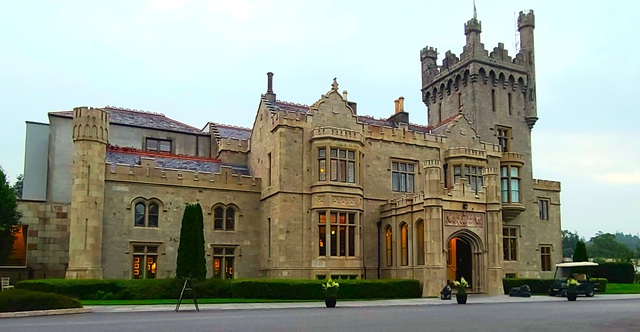
Lough Eske Castle Hotel
I was equally happy to return to the Donegal Golf Club—sometimes, and somewhat confusingly, also known as Murvagh—especially with the welcoming presence of the then relatively new general manager, Lynn McCool.
The club has existed since the 1950’s, but Lynn pointed out that a trio of Irish golf legends have done work on the current course: Eddie Hackett, who did the original design in the early 1970’s; Pat Ruddy, who did virtually annual tinkerings beginning in 1991 until his recent retirement, and now former Ryder Cup captain Paul McGinley.
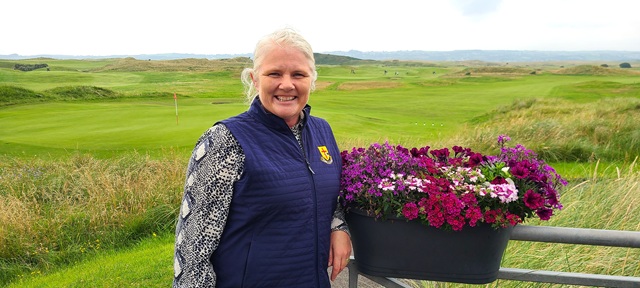
Lynn McCool
[Another earlier story, about Ruddy and Hackett and Donegal, is also up at Sports Illustrated here.]
McGinley’s parents were from the county and he visited many times in his younger days. Like Ruddy, he’s maintaining respect for Hackett’s original routing, while making subtle changes over the last few years with an eye toward increasing playability.
Like the watery seventh hole par-3 at Glashedy (“Loch na nDeor” or Lake of Tears), the fifth hole par-3 at Donegal is named the Valley of Tears. No water to contend with here, but a long semi-blind shot over uncertain terrain. If less hilly and rugged than Nairn & Portnoo overall, Donegal is nonetheless a soul-cleansing walk in nature, jutting out toward the Atlantic on the Murvagh Peninsula.
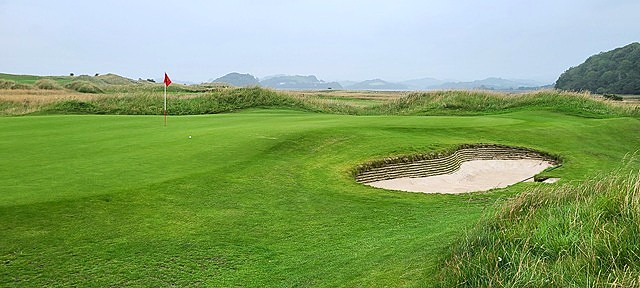
Donegal Golf Club
McCool said there’s been an uptick in golfers traveling to Donegal and other northwest courses, “and that’s testament to Paul’s work and to the lure of links golf overall. When the breezes shift, every day is different here, and the courses in our area offer such a tremendous amount of variety that anyone who is an avid golfer should come.”
(And if you do, it wouldn’t hurt to cart along some literature by a Donegal favorite son, the late Brian Friel. While better known as a playwright (Dancing at Lughnasa and others), Friel penned a lot of short stories. In this post, I urge readers to check out one in particular, “The Widowhood System.” You won’t be sorry.)
No argument there. We were the next county south at Rosses Point the next morning and it was all uphill from the first hole at County Sligo Golf Club—or so it sometimes seemed at this challenging but gorgeous course.
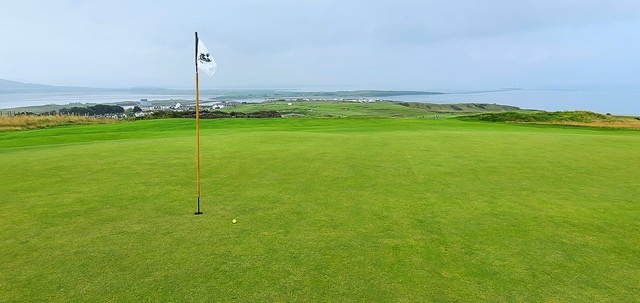
County Sligo Golf Club
A club was established here in 1894, though it wasn’t until Lindbergh crossed the Atlantic in 1927 (if not to play golf) that Harry Colt began working on the routing that largely exists today. Colt, as in Wentworth and Sunningdale.
What changes were made in 2013 and following years were engineered by the usual suspect, Pat Ruddy, who with an eye toward more current equipment made the course even more of a championship test. (The course is also called the Colt Championship Links.)
There’s no escaping a sense of drama here, with the senses swirling in the ocean breezes and with the views of surrounding mountains and meadows. The course has stood the test of time as the home of the West of Ireland Amateur Golf Championship since 1923, a test passed by the likes of Rory McIlroy, Shane Lowry and Padraig Harrington. Although my favorite story told is the one about a young Bernard Langer, who once came here for a day and left a week later.
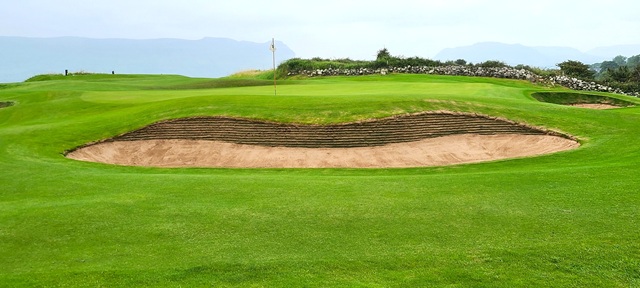
Easy approach shot at the Sligo ninth
The clubhouse also gets my vote for the best bangers and mash, the perfect post-round wrap-up. And for dessert you could always play the short Bomore Course nine, designed by Jonathan Tucker.
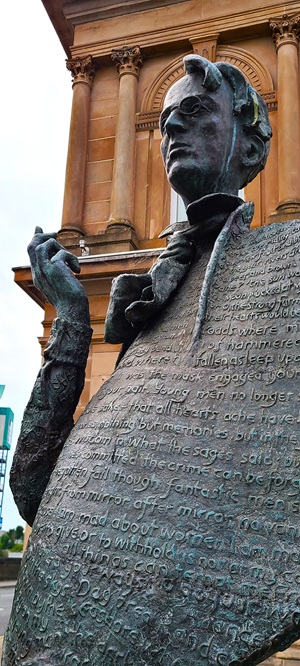 County Sligo is Yeats country. From our perch at the Radisson Blu Hotel we had a grand evening strolling its streets, with a modern Yeats statue on hand, from the Thomas Connolly pub to the Eala Bhán restaurant to D. McLynn’s pub, where we ran into the live music we were seeking. Emphasis on the grand.
The Wild Atlantic Way actually stretches from the north down south toward Cork, which is Murphy’s Stout territory, but I picked up some useful information on the black stuff at Thomas Connolly’s pub from locals Emmet McLoughlin and Domhnall Melly: “A can of Murphy’s is better than a can of Guinness; but draft Guinness is better than Murphy’s.” Be advised.
The chef/owner at the superb Eala Bhán is Anthony Gray, who in an earlier incarnation was the professional at the Strandhill Golf Club, where we played our final round on our last, alas, full day in Ireland.
The club at Strandhill was formed in 1931, and other than work on nine holes from a Dublin designer, John McAllister in 1939, the course evolved through member design into its current 18-hole routing in 1973. For the last few years architect Ally McIntosh has been reworking and improving the course.
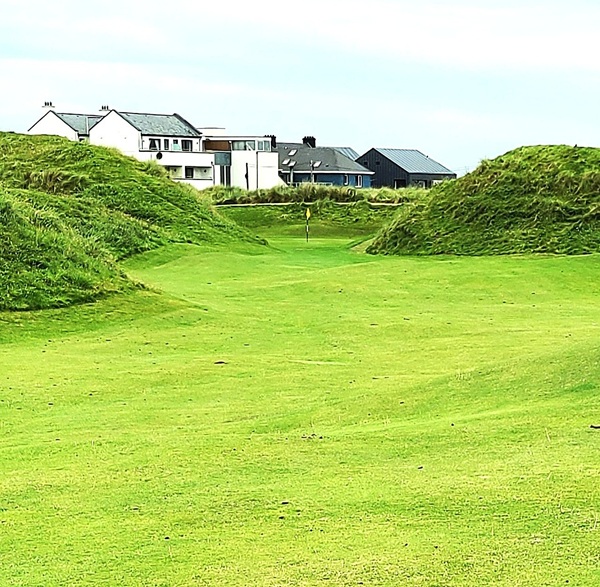
Threading the needle at Strandhill
At just under 6,200 yards to a par of 70, this was the most forgiving course on our journey, a compact, occasionally quirky, often hilly links experience. The quirk of the course is dialed all the way up to 11 on the 361-yard par-4 thirteenth, called The Valley.

Riders on the shore
The hole takes a right turn some distance off a way-elevated tee, so immediately club selection is puzzling—safe and short straight ahead (and down), or cutting the corner with a driver? Once in the fairway you have to thread through two large dunes to a barely visible and tiny green. Players find the hole alternately maddening, or fun.
As with all the links courses we played, Strandhill offered still more incomparable views of land, sea and sky. On the fourth tee alone we had the full view of Knocknarea Mountain, while four riders on horseback pranced below us in the Culleenamore Strand.
The Benbulben (or Ben Bulben) rock formation is ever present as well. It is there at the St. Columba’s cemetery in Drumcliffe Churchyard, at the foot of Ben Bulben, that Yeats wanted to be buried. And so he is.
This piece appeared originally in the 2026 Travel & Directory Issue of Golf Oklahoma in slightly different form.

