
 What a pleasure it was this time out to read three books about golfers not named Tiger Woods!, from the historically important Alexander Findlay to the more recent but no longer playing Ian-Baker Finch and Jay Delsing.
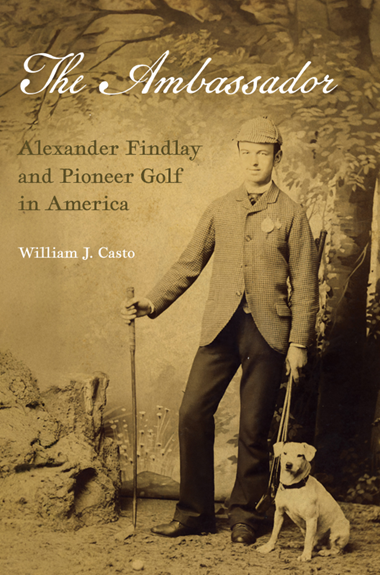
In The Ambassador: Alexander Findlay and Pioneer Golf in America (Back Nine Press, $34.99), William J. Casto lays out a brief for including Alex Findlay in the Golf Hall of Fame. It’s a convincing one, and a rollicking good read beside, because Findlay was an utter original.
One of six brothers, many of whom also became involved the game, Findlay was born in Montrose, Scotland in 1866 and took up the game because all the other boys he knew were playing it. None became as besotted by it as Alex, or as fierce in trying to disseminate the game throughout the world. Hence the book’s title, the sobriquet Alex preferred, though he eventually was often referred to as the Father of American Golf.
Findlay packed a lot into his life, including rounds at almost 2,500 different courses worldwide before his death in 1942 at 75. He could play with the best of golfers of his time, but tried to hold fiercely onto his amateur status throughout his life, including never taking any money for the many courses he designed, reworked or consulted on.
He came to the U.S. in 1887, though not to be a golfer, but a cowboy in Nebraska. But he soon rode out on the prairie with his golf clubs, resulting in episodes that sound like they’re right out of “Little Big Man.” He whacked a golf ball on April 4, 1887 that Casto guesses is among the first confirmed strikes of one within the United States. Soon he laid out a six-hole course and try to convince others to join him. Sioux Indians would watch him in amazed bewilderment, including Chief Sitting Bull. Buffalo Bill Cody saw it all and called Alex a “total idiot.”
Years later Findlay tried to convince Pope Pius XI to build a six-hole course at the Vatican. That’s one story I always meant to write up with the title “The Man Who Wanted to Golf With the Pope.” Casto has beaten me to it.
He has also done impressive research into the rest of Findlay’s career—bringing British stars like Vardon and Ray and Joyce Wethered to the U.S. for exhibition matches, his endless proselytizing on behalf of the game believing it could cure the world’s ills, his work in sporting goods for Wright & Dixon in Boston and Wanamaker’s in Philadelphia, his extensive course work. It’s all quite remarkable.
Architect buffs will eat up the detailed—if a bit geeky—section on Findlay’s course creations. Casto feels there were surely more, but he identified 165 courses that Findlay contributed to in some way, most no longer existing. (Though there is what is thought to be Oklahoma’s oldest course, the nine-hole Guthrie Golf & Country Club.)
He guesses there are perhaps 66 that retain some elements of Findlay’s work, and he details them all in a lengthy appendix. Not listed, alas, is a six-hole Vatican course.
* * *
 In Ian Baker-Finch: To Hell and Back (Hardie Grant Books, $35), Geoff Saunders charts the life and career of the popular golfer and subsequent tournament broadcaster (who just retired after a 30-year post playing-career career).
Though this is an “authorized” biography, there are few who would argue that Baker-Finch is a fine and decent man, who had a few years of solid success. But there’s no getting around the fact that he had a precipitous decline, when he completely lost his game. That’s the Hell part of the story.
Born in 1960, Baker-Finch grew up in Peachester, Australia, and was drawn to the game through his father’s interest in golf. By age 14 he was basically teaching himself by assiduous study of a book his parents gave him for his birthday: Golf My Way by Jack Nicklaus.
It was the best studying he could have done, not being that keen on school. He turned pro at 19 and Saunders has a grand time recounting some of the early wild days on what Baker-Finch’s friend and contemporary Wayne Grady called the Troppo Tour, Australian slang for a tropical derangement. The Sunshine Tour may have played at less than stellar courses, but it gave the players valuable experience and an ability to handle any course conditions.
Except maybe the greens at Augusta, which Baker-Finch said he never could quite get a handle on. And he was considered a wizard with his short game, particularly his putting. It certainly all came together in 1991. By then he was playing on the PGA Tour, and at Royal Birkdale he walked off with the Champion Golfer of the Year Claret Jug.
A scant three years later, his game was in shambles. After 1994 he never made another cut on the Tour, and following a disastrous performance in the 1997 Open Championship he hung up the spikes. (Well, there was some later success in paired events on the Champions Tour.)
Saunders does his best to detail the causes for the breakdown of Baker-Finch’s game, though it seems a reasonable combination of swing tinkering, physical ailments and mental anguish. Intriguingly, similar collapses happened to Bill Rogers, the 1981 Open Champion, and David Duval, the 2001 Open Champion. (Darren Clarke won in 2011, Collin Morikawa in 2021.)
If a sobering tale, Saunders makes it clear that there’s no need to shed tears for Baker-Finch. He went on to his broadcasting career, has had a long and happy marriage to his wife, Jeannie, who says in the book that he achieved his life’s dream, winning the Claret Jug. No small thing.
***
 Jay Delsing, writing with Will Saulsbery in You Wouldn’t Believe Me If I Told You (Mascot Books, $28), serves up a tasty smorgasbord of anecdotes from his life and his life on the PGA Tour.
It’s a little hard to say who had the better career, Baker-Finch or Delsing. The latter never won a PGA Tour tournament, while Baker-Finch won twice, including the 1991 Open Championship. He earned $2,078,743, making 92 cuts out of 167 tournaments with 23 top ten finishes.
But Delsing had the longer and more lucrative journeyman career, earning $3,608,666 in 565 tournaments over roughly 25 years, making the cut 276 times, with thirty top ten finishes.
But who needs to compare? Delsing isn’t here for the glory, but the laughs. And he delivers plenty of them. There’s no hard and fast chronology involved, but Delsing covers the waterfront, from his early days in St. Louis as the first boy of five children, thereby (he says) inheriting the sporting mantle from his dad, Jim, who had a ten-year major league baseball career.
Jay’s mania was golf. He grew up playing at a club he calls so exclusive, “that it’s currently a poorly producing soybean field.” He parlayed his youthful success into a sterling college career at UCLA. Which manages to set the scene for his first anecdote—while practicing as an 18-year-old freshman at the Bel-Air Country Club, Delsing was asked if he’d like to play nine holes by none other than Sean Connery. Delsing interrupts the narrative to give a brief stat sheet on Connery:
“SEAN CONNERY. Edinburgh. Scotland. 6’3”, 165 lbs. 1953 Mister Universe contestant. One Oscar win. $3,103,469,655 in box office earnings. James. Bond.”
Delsing does this every time he introduces a new character in a new anecdote, and it manages to be funny every time. And there are a lot of characters, mostly from the golf world—Palmer, Nicklaus, Johnny Miller, John Daly, Steve Pate, Hale Irwin, et al.—but Tommy John shows up, Tom Seaver, Justin Timberlake, Jimmy Connors and many others.
 There’s a funny and poignant chapter about his dad, a sweet section on his daughters. But mainly this is just over 200 brisk pages of entertaining tales from the tour. Good enough to hope for a sequel.
# # #
TOM BEDELL. Vermont. 6’0” 194 lbs. Broke 80 once. No aces. Plays piano. Cooks. Reads a lot of golf books.
This piece first appeared in the Oct-Nov 2025 issue of Golf Oklahoma, in slightly different form.
