Pete Dye’s Legacy at Casa de Campo

P.T. Barnum in khakis. That’s how I think of Pete Dye. Artist. Salesman. Impressario. And golfer. When I called him at his winter home in Delray Beach, Fla. the other day to congratulate him for the ‘Best New’ awards showered on his mammoth new course at French Lick Resort in southern Indiana, he was pleased to hear from me but was also eager to get off the phone. He had a game that morning at Gulf Stream Golf Club, where he’s a member.

While he’s too modest to admit it, Pete, who turns 85 in 2010, can count on two hands the number of times he hasn’t broken his age. He still hits a high draw, still has a good short game, still looks like the guy who won the Indiana State Amateur championship five times with forged blades and persimmon woods.

My real reason for calling Pete was to ask him about what he’s been up to at his second winter home, a place he been visiting for the better part of 40 years, a Caribbean destination where his design legacy spans five decades. A place in the sun where he’s “still digging,” as he likes to say.

You can find more exclusive getaways in the Caribbean, ones with sandier beaches and much higher prices. But search the islands far and wide, and you will not find a more complete resort, or one with better golf, than Casa de Campo, a vast 7,000-acre playground in the Dominican Republic. Yes, it gets its share of movers and shakers, from rappers and models to CEO’s, but they don’t come here to bask in their celebrity. They come to Casa to let down their hair and have a good time in a sun-kissed place where the sunny-natured Dominicans are all smiles.

With an ambitious expansion and rehabilitation program completed in December, 2009, the property, thanks to its part-time resident designer, has distanced itself from the competition. Other Caribbean resorts have struggled of late, but the sugarcane barons who control Casa de Campo (‘House in the Country’) treat the resort as a little side venture. Given the rising price of sugar, that’s just what it is.

While Dye is proud of the courses he’s built (and continues to build) at the resort, he’s especially proud of the fact that Casa de Campo, a resort put on the map by golf, has provided jobs to tens of thousands of the “warmest, most gracious” people in the world, as he describes the Dominicans.

Dye first visited the Dominican Republic in the late 1960’s. The DR, which shares the island of Hispaniola with Haiti, was a struggling banana republic in the post-Trujillo era. P.B. Dye, Pete’s younger son, has regaled me with stories about how long it once took to get from Santo Domingo, the capital, to La Romana, home of Casa de Campo. This was before roads were paved, before bridges were built to span the many rivers that flow from the mountains to the sea.

“Four hours?” I asked him. (It’s normally a 90-minute drive). “Are you crazy? Seven or eight hours. Chrissakes, we had to swim across some of those rivers and camp out on the other side,” P.B. remembers.

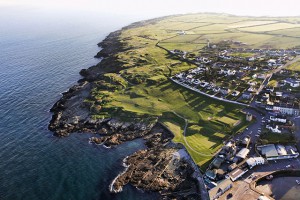
When Pete arrived in La Romana, the town’s sugarcane operation was the only game in town, though company executives envisioned a golf resort complex that would spur tourism. Dye surveyed the island’s wild, rocky southeastern shore by air but couldn’t learn much about land from the window of a helicopter. So he commandeered an old motorboat, affixed a long tow rope marked in 100-yard sections to the stern, and spent a week puttering along the coastline to get a feel for what would fit where. Mangrove, sea grape and cactus covered the encrusted coral along the shore. Working without benefit of a formal plan, he conjured a routing that would bring players to the sea on both nines. Dye toiled alongside 300 Dominican laborers armed with machetes who cleared the land of its underbrush and later pulverized the limestone with pickaxes. Pete heard the natives refer to the sharp, ivory-yellow coral rock as diente del perro—“teeth of the dog” in Spanish—which is how the golf course came by its name.

Because the bulldozers and backhoes required to build a golf course were prohibitively expensive to import, Pete and his team had to rely on basic machinery used for growing and harvesting sugarcane. Oxen-drawn carts brought red dirt and cachaza, a byproduct of the sugarcane refining process, to the site, where it was mixed with sand to create a medium for the turfgrass. After the composite soil was spread and raked, the fairways, tees and greens were hand-sprigged.

In his book, Bury Me in a Pot Bunker, Dye said he “learned firsthand that land responds more positively to the raw-boned hands of the laborer than to the steel-faced jolt of heavy machinery. Whatever delicate features Teeth of the Dog possesses are a direct result of the hard work of those Dominicans who took such pride in their work.” Shaped and molded by islanders who had fallen under Dye’s aw-shucks spell, Teeth of the Dog is still very much the hand-built beauty that opened for play in 1971.

For drama and beauty and challenge, there’s no course on Pete’s resume I’d place ahead of Teeth of the Dog, but by the turn of the millennium the layout’s playing surfaces and features had deteriorated badly. It was beaten up and needed work.

To celebrate his 80th birthday in 2005—the man never sits down—Dye pried open the jaws of the Dog to have a look at its choppers. At first a minor makeover was contemplated, but Pete got out the big drill once he realized the layout no longer instilled fear in the heart of experts from the tips at 6,989 yards (par 72).

After the greens on the links were resurfaced in salt-tolerant paspalum grass, Dye began pushing back tees, digging new bunkers and altering hole angles. With significant alterations at nearly every hole, Dye, greatly influenced by a visit to Scotland in 1963 but also a fan of Seth Raynor’s work, turned his seaside gem into a tartan beast. At the par-five third, for example, Pete added 50 yards to bring the right-hand fairway bunkers into play. By taking out the restrooms behind the fourth tee, he added nearly 100 yards to a formerly petite par four that now doglegs sharply to the right. The fifth, a jewel-like par three cantilevered into the sea, is a wee pitch to a tiny green from the forward tees, but a different shot altogether from the brink of a sea wall at 175 yards.

Dye also redid the brilliant stretch of holes at 15, 16 and 17, each of which hugs the coast and plays into the prevailing wind. The par-four 17th, a demanding Cape-style hole that calls for a bold carry over an inlet of the sea, now stretches to over 475 yards, its back tee sited on a corner of the 16th green. The hole plays to an enlarged green that Pete somewhat made look smaller.

In sum, Dye ended up turning his little pet into a pit bull, at least from the new black tees at 7,471 yards (75.9/145). No pro or scratch player will ever again be able tiptoe around the course with a few Milk-Bones in his pocket.

On the other hand, Teeth of the Dog remains one of the most delightful resort courses in the hemisphere from the middle tees. Women feel the same way about the course from the red tees at 4,906 yards. They have Pete’s wife, Alice, to thank for the friendly set-up—it was she who placed the markers.

As Pete has noted in the past, other courses have holes that run along the sea, but Teeth of the Dog’s keepers are in the sea. Three of these holes are spine-tingling par threes with more surf than turf in play, but the inland holes, routed through sugarcane fields and mature trees, are the strategic glue that holds the Dog together. A third or fourth round on the walker-friendly links with a Dominican caddy at your side reveals Dye’s genius: doglegs perfectly angled, hazards ideally placed, a balanced routing with excellent pace and variety.

The verdict: With its nose-to-tail makeover and vastly improved conditioning, Teeth of the Dog now deserves its acclaim as the finest tropical golf course in the world. It’s numero uno. But it’s not the only reason to visit Casa de Campo.

Even in the wake of its facelift, Teeth of the Dog looks downright petite compared toits sibling, Dye Fore. This epic creation, which required earthworks so major they were performed at night so that management would not become alarmed, stairsteps down bluffs 300 feet above the Chavon River. A majestic test intended to redefine golf in the tropics and withstand the onslaught of equipment technology for at least a few years, the course is as bold as anything Dye has ever done. And that includes Whistling Straits.

For starters, entire valleys and ravines were filled to create landing areas on the deeply incised tableland. An engineering marvel, Dye Fore debuted in 2003 after nearly five years of planning and construction. The giant greens, enormous bunkers and sharp elevation changes will grab a first-timer’s attention, but so will the views: the river far below, the sea flooding the horizon, tall mountains rising from the interior and, at the finish, Altos de Chavon, the resort’s cliff-hanging replica of a 16th-century Mediterranean village. Multiple sets of tees allow the course to play from 5,225 yards to an ungodly 7,714 yards (par 72), although most players will have all they can handle from the middle tees at 6,520 yards on a typically windy day. The visual intimidation, optical illusions and sheer scale of the layout must also be factored in.

Dye Fore’s clarion note is sounded at the fourth hole, a downhill, downwind par four measuring more than 500 yards from the back tees that sweeps from right to left. The fairway snakes along the top of a promontory as it descends, the mouth of the river and the sparkling sea in the far distance. The green, like many on the course, is a rippled, infinity-edge wafer that makes distance assessment difficult. The entire left side of the fairway drops off steeply to a jungle from which there is no recovery. The Chavon River, which resembles a tea-colored tributary of the Amazon, crawls along more than 200 feet below the cliff.

The fifth is another downhill par four that bends to the left along the bluffs, only here the overall distance is shorter and the angle of the dogleg sharper. Well-placed bunkers on the right force players to lay up or veer dangerously left near the cliff, while the second shot, depending on pin placement, must carry a corner of the gorge. These two holes, possibly the best back-to-back par fours in the Caribbean, are a like a pair of crashing cymbals designed to rivet your attention.

Dye Fore’s front nine concludes with a pair of doozies. The massive, Z-shaped par-five eighth, measuring over 600 yards from the tips, bobs and weaves around haystack-shaped hills and oblong bunkers, the target a tiny green guarded by a sand-filled trench. The par-four ninth could pass for one of Pete’s holes at PGA West or Sawgrass: A long waste bunker flanks the entire right side of the curving fairway, the entry to the long, deep green bottlenecked by mounds left and sand right.

As good as the front nine is, and it’s fabulous, Dye Fore’s incoming nine, which initially reverses direction and heads north toward a range of sawtooth peaks in the distance, is jaw-dropping. The 12th is the first of two world-class par threes, a king-sized one-shotter that calls for a bold stroke over a deep, angled ravine, its amber rock face pitted with agave plants. The green, set perilously close to the edge of the cliff, is guarded by a coral-trimmed bunker. Far below to the right are the lush banks and flood plain of the Chavon River, where the helicopter scenes in the film Apocalypse Now were shot.

The course then makes an interior two-hole loop before delivering players to the tee of the majestic par-three 15th. In terms of terror, it’s comparable to the 12th, only here the hole points north into the prevailing tradewinds, the river’s lazy coils far below on the left. The vegetation-choked ravine that stands between tee and green is ominous and broad, but there’s a generous bail-out area to the right. Hook a tee shot here, and your caddie is likely to intone, “Hasta la vista, senor.”

As a grand-scale test, Dye Fore has few rivals in the tropics or anywhere else for that matter. The course, which reveals the designer’s extraordinary will and imagination, offers ample room to drive the ball, but there are consequences for wayward approach shots. Dye’s artful chicanery is in evidence, too. In the words of Gilles Gagnon, the resort’s long-time director of golf, “Pete has the ability to make the easy holes look hard, and vice-versa.” The subtly contoured greens are marked by long, flowing slopes. They’re slick and tough to read.

Because the resort has acres to spare and because management is quick to accommodate Dye’s desire to keep digging, Pete is building a second 18 at Dye Fore. I asked him how the project is proceeding. “Got nine holes completed, second nine’s gonna be done in the spring,” he quipped. And when will the entire 18 open? “Maybe next fall,” he said. Given the fact that he works with a very small crew at Casa de Campo, mid-2011 is a more likely timeframe. At that time, the existing Dye Fore layout will most likely be split in half to accommodate the new loops. Doing so would create a rugged upcountry north course stretched regally along the river bluffs; and a flatter but no less interesting south course that proceeds from rolling foothills to the resort’s marina at the mouth of the river.

Needless to say, there will be enough drama and spectacle at both courses to tame and entertain golfers of all stripes for decades to come. Coupled with Teeth of the Dog, the 36-hole Dye Fore complex is a perfect 40-year bookend to Pete’s extraordinary design achievements at a resort he describes simply as “my favorite place.”

While not in a class with Teeth or Dye Fore, the Links, an upcountry design that Dye co-designed with associate Lee Schmidt in 1976, is a good choice for a warm-up round. The layout climbs into rolling hills above the resort’s polo fields, its fairways lined by chest-high guinea grass and thick stands of trees. Deane Beman was once quoted as saying that the 6,664-yard layout owned the finest set of greens he had ever played. These small sloping greens, coupled with numerous lagoons, tend to keep players honest.

A fifth Dye creation, La Romana Country Club, is a spacious, hilly course that relies more on conspicuous design features, notably mounds, than the other layouts at Casa de Campo. It is private club intended for the use of the resort community’s property owners, but a handful of guests are usually accommodated on weekday mornings. Access is not advertised. Check with the resort’s director of golf about securing a tee time on this members-only spread, which is beautifully framed by citrus groves and exudes a genuine country club ambience.

New this season at the resort is a David Leadbetter Golf Academy headed by Englishman Tim Vickers, who caddied for Michelle Wie (a Leadbetter pupil) for 18 months and will give Casa a sine qua non in today’s market—a high-teach facility dedicated to swing improvement.

While golf is Casa de Campo’s calling card, the resort is a mecca for outdoor sports enthusiasts. La Terraza Tennis Center has 13 composite Har-Tru courts, 10 lighted for night play (it’s known as the ‘Wimbledon of the Caribbean’). The resort’s Sporting Clays Shooting Center offers more than 100 sporting clays stations and a 110-foot target tower with multiple launch levels. A large equestrian center organizes guided trail rides (English or Western saddle) along paths that skirt the golf courses, sugarcane fields and river. From November through May, world-class polo is played at Casa de Campo. The matches are spectacular. There is fishing on the Chavon for snook, a noble quarry, and in deeper waters for bigger game. Charters and catamarans are available for excursions to Catalina Island, the resort’s private island located a half-hour offshore, where the snorkeling is very good. Or stay closer to home and paddle a kayak up the river. Return later in the day for a sunset paddlewheel cruise on the Chavon, a festive and relaxing experience.

The resort raised its profile several years ago when it opened a $30 million Marina & Yacht Club near the mouth of the Chavon River. With its waterside cafes and trendy shopping outlets, it resembles a well-proportioned piazza in the Italian Riviera. Visitors are often treated to impromptu merengue lessons at night.

There are also supervised programs for children as well as teenagers at this family-friendly property. For kids who love sports, the resort offers baseball and soccer clinics for kids ages six to 14. These clinics are headed by former professional and major league players native to the Dominican Republic. For children interested in the prehistoric cultures who once lived here, a pre-Columbian workshop at the Archeological Regional Museum at Altos de Chavon offers a window into the Taino Indian culture.

A word about Altos de Chavon, the resort’s one-of-a-kind stage set built high in the sky above the river. Under the direction of Italian cinematographer Roberto Copa, the rustic village, distressed to look centuries old, was hand-built of stone, wood and iron by local artisans in the mid-1970s. Rough cobblestone streets, shady pathways, cool fountains, a tiny church and the aforementioned museum are found here, as are balustrades cantilevered over cliffs that offer dizzying views of the river, sea and mountains. Seemingly airlifted from Athens is a 5,000-seat, open-air amphitheater where concerts are held.

New this season at Altos is a sports bar, dance club and Casa Montecristo, a cigar lounge that doubles as a showcase for Tabacalera de Garcia, the largest hand-made cigar factory in the world. (The factory, located in La Romana’s Industrial Free Zone, produces more than 30 million cigars per year for the likes of Montecristo, Dunhill, H. Upmann, Romeo y Julieta and many others).

Altos de Chavon also functions as a working artist’s village. Quaint shops, art galleries and boutiques are spaced along its narrow, winding lanes. Among the items for sale are rare gems native to the island. Amber, a fossilized resin that oozed from prehistoric pine trees and trickled down mountain slopes some 50 million years ago, is found only in the Dominican Republic, Russia and Germany. Treasured by ancient cultures–amber and diamonds are the only gems of vegetable origin—the honey-colored substance is made into jewelry. Many of the amber pieces collected flora as well as small creatures and insects before they hardened. These flotsam are preserved within the semi-translucent tree sap. “Stories in stone,” the locals call them. The new World of Amber Museum tells the whole story.

Also available is larimar, a stone unique to the Dominican Republic. Noted for its hardness, larimar derives its pale blue color from the unusual presence of copper in the stone. Resembling turquoise, it is made into rings, bracelets and necklaces.

The only weak links in the Casa de Campo chain—its accommodations and restaurants—were fixed as of December, 2009, when 80 new Elite hotel rooms and Elite suites were unveiled. With their rich fabrics, mahogany wood furnishings, louvered patio doors, high-tech amenities and nicely appointed bathrooms, they’re a big improvement over the solidly built but more basic rooms that date to the 1970’s.

In the resort’s new main reception area, Dominican designer Mayra Gonzalez used Coralina stone and large open spaces accented by water features to create a favorable first impression at check-in. Within the main complex is La Cana Restaurant & Lounge by Il Circo, a fine dining restaurant with both indoor and al fresco dining. The restaurant has been created under the guidance of the Maccioni family of Le Cirque, the fabled New York dining establishment. The Maccioni family has also transformed the old El Pescador restaurant into the beautiful Beach Club by Le Cirque at the resort’s Minitas Beach.

The golf at Casa de Campo was always great thanks to the tireless efforts of the world’s greatest living designer. Now the resort’s creature comforts are a match for Pete’s inspired handiwork.

Archive

  • Forest Dunes: Bargain of the Century

    Forest Dunes Golf Club, a 1,300-acre development in north central Michigan with a superb Tom Weiskopf-designed course at its core, was completed in 1999 for a reported $40 million but was abandoned before it ever opened. Conceived as an upscale real estate development, the club was later revived by the Detroit Carpenters Pension Trust Fund (one of the original lenders) and reopened 10 years ago. In the face of economic headwinds, it has managed to survive as a semi-private club. In a telling sign of the times, Forest Dunes was purchased in January 2012 by Lew Thompson, a trucking company executive ...

  • Costa Navarino: A Greek Bail-Out

    Paging through The Economist last week, I learned that the beleaguered Greek government would miss its budget-deficit targets for this year and next. The country’s deepening recession is to blame. Predictably, euro-zone finance ministers responded by saying they would not hand over the latest tranche of bailout funding ($10.7 billion) to Greece until mid-November, a month later than expected. On cue, Greek unions staged another general strike to protest the latest austerity measures. Given this sand-in-the-hourglass scenario, it was very surprising to find out that a new resort golf course opened in late September in the Greek region of Messinia, in ...

See more from Brian McCallen...